
How Stress and Sleep Affect Fat Loss (And a 7-Day Reset Plan That Works)
Stress and poor sleep can quietly block fat loss, even with diet and workouts in place. Learn how modern lifestyles affect hormones, metabolism, and how a simple 7-day reset can help.
Vipinrajworld
12/29/20255 min read
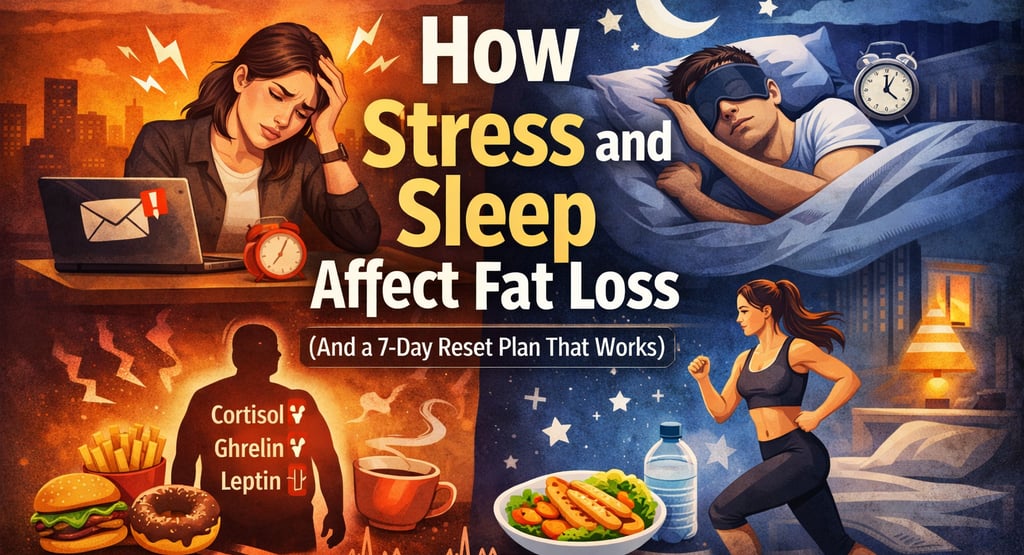
Have you ever been consistent with your diet and workouts yet still struggle to lose fat? You’re eating right. You’re training regularly. But the scale barely moves. The reason might not be what you’re eating or how hard you train — it might be stress, poor sleep, and modern lifestyle patterns silently sabotaging your progress.
In this blog, you’ll discover the science behind how stress and sleep disrupt fat loss, why focusing only on calories and workouts isn’t enough, and a straightforward 7-Day Reset Plan that tackles these hidden barriers.
Why Stress and Sleep Matter More Than You Think
When it comes to fat loss, most people obsess over food and exercise. They think this is enough to get the desired results. But your internal environment — the hormones, stress responses, sleep rhythms — plays a crucial role in whether your body actually burns fat or even gain muscles.
Here’s why:
1. Chronic Stress Elevates Cortisol — the Stress Hormone
When you’re stressed, your body secretes cortisol, a hormone designed for survival. In short bursts, cortisol helps you deal with threats. But in modern life, stress is constant — from work deadlines, traffic, to juggling responsibilities — keeping cortisol elevated over long periods.
High cortisol levels:
Increase hunger and cravings — especially for sugary and high-fat foods (because they provide short term comfort).
Promote fat storage, particularly in the belly area.
Disrupt sleep patterns and Muscle recovery.
This means your body is essentially in survival mode - storing calories instead of burning them efficiently.
2. Poor Sleep Disrupts Hormones That Regulate Appetite and Metabolism
Sleep isn’t just rest — it’s when your body repairs, resets hormones, and balances metabolic function. When you don’t sleep enough:
Ghrelin (hunger hormone) rises - making you feel hungrier -> Leads to indulgence.
Leptin (fullness hormone) drops - so you feel less satisfied after meals (You eat more calories without even realising).
Cortisol stays elevated overnight - promoting fat storage and evening cravings.
Studies show that individuals following calorie-restricted diets lose less fat when they’re sleep deprived compared with those who get sufficient sleep.
3. Modern Lifestyle Patterns Disrupt Your Internal Clock
Irregular schedules, late-night screen time, inconsistent meal timing, and chronic stress all interfere with your circadian rhythms — the internal clock that regulates metabolism, hunger, digestion, and hormone release.
When this rhythm is disrupted:
Digestion becomes less efficient. Less nutrient absorption and most of the food goes to waste.
Metabolic flexibility (how your body switches between burning carbs and fat) falters.
Appetite cues become harder to read - Your body will be hungry but you won't notice it.
This is one reason why two people with similar diets and workouts may experience very different results.
The Vicious Cycle: Stress → Poor Sleep → Fat Loss Resistance
Here’s how this feedback loop plays out:
Stress increases cortisol and disrupts sleep quality.
Poor sleep alters hunger hormones, leading to increased cravings and calorie intake.
Elevated cortisol and disrupted appetite signals make it harder to adhere to healthy eating and training plans.
Cravings and low energy result in poor food choices, skipped workouts, and plateaus in fat loss.
You may be doing all the right things on paper — yet your body's Internal system isn’t aligned to support fat loss.
The 7-Day Reset Plan: Return Your Body to Fat-Burning Mode
This reset isn’t about extreme dieting or punishing workouts. It’s about resetting your hormonal environment — reducing stress, improving sleep and metabolic balance.
Each day includes simple, actionable habits that build on each other.
Day 1: Prioritise Consistent Sleep
Set a target of 7–8 hours of sleep. Aim to go to bed and wake up at the same time each day. Sounds hard but in reality it is a matter of few days and then you get in routine.
Night routine tips:
Avoid screens an hour before bed or at least 30 mins before sleeping.
Keep room cool and dark. Use a sleeping mask if needed.
Reduce caffeine intake after 4-5pm.
Why it works: Consistent sleep patterns help stabilise cortisol and hunger hormones — laying the foundation for recovery and fat loss.
Day 2: Stress Audit and Micro-Breaks
Identify your top 3 daily stressors (work inbox, meetings, personal to-dos). For each, add a micro-break of 5 minutes — deep breathing, stretching, short walk (get up for 5 mins and walk around).
Goal: Break chronic stress signals throughout the day.
Why it works: Frequent micro-resets reduce cortisol spikes and improve emotional resilience.
Day 3: Balance Your Meals With Protein, Fat and Fibre
Your meals should now include:
Protein at every or the Big 3 meals — to support satiety and lean mass.
Healthy fats — for hormone balance.
Fibre-rich carbs — to stabilise blood sugar.
Why it works: Balanced meals prevent blood sugar crashes and reduce evening cravings — a common outcome of poor sleep and stress.
Day 4: Add 10 Minutes of Movement Post-Meals
Complete a 10-minute walk after your largest meals.
Why it works:
Lowers post-meal blood sugar spike.
Improves digestion.
Calms the nervous system before sleep.
This simple addition supports both metabolic health and stress reduction.
Day 5: Mindfulness or Breath work Session (10–15 minutes)
Pick one practice (Could be done during evening or at the end of the day) :
Diaphragmatic breathing
Guided mindfulness meditation
Progressive muscle relaxation
Goal: Activate the parasympathetic system (rest and digest), countering chronic stress.
Why it works: These practices decrease cortisol and improve focus and metabolic regulation.
Day 6: Reduce Late-Night Eating
Avoid eating at least 2 hours before bed.
Late-night meals can:
Disrupt circadian rhythm.
Impair sleep quality.
Increase fat storage signals.
Why it works: This creates a consistent eating window, supporting metabolic rhythm and better sleep quality.
Day 7: Review and Adjust
Evaluate your:
Sleep duration and quality.
Stress patterns and triggers.
Energy levels through the day.
Identify:
What worked.
What hindered progress.
One habit to build next.
This reflection makes the reset sustainable instead of one-off. This can be done at the end of every week to get a better understanding of how your body is reacting to these positive changes.
What You Should Expect After the Reset
If you practice these habits consistently:
You’ll notice reduced cravings and better appetite control.
Your stress tolerance improves in daily life.
Exercise sessions feel more energetic and productive (More fat loss or Muscle gain).
Your body responds better to calorie balance because your hormonal environment supports fat loss.
This is the real reason many people hit plateaus — not because of lack of effort — but because their internal physiology isn’t optimised.
Final Words: Your Lifestyle Matters as Much as Your Diet
Fat loss isn’t just about calories in vs calories out. It’s about calories in vs energy utilisation, which is heavily influenced by stress and sleep patterns. When you address the hidden barriers — stress, disrupted sleep, and lifestyle misalignments — your fat loss becomes not only possible but sustainable.
If you’ve tried dieting and training hard but still feel stuck, it’s likely these invisible forces are working against your progress.
Want Faster, More Predictable Results?
I’ve helped many people including working professionals who were frustrated with plateaus and inconsistency. In my 90-day transformation program, you’ll get:
Personalised nutrition planning based on your lifestyle
Strength and metabolic training guidance
Sleep and stress optimisation support
Accountability and expert coaching every step of the way
No fads. No confusion. Just a scientific, proven strategy that finally works for you.
Apply now to secure your spot and transform your health in 90 days. See you soon!